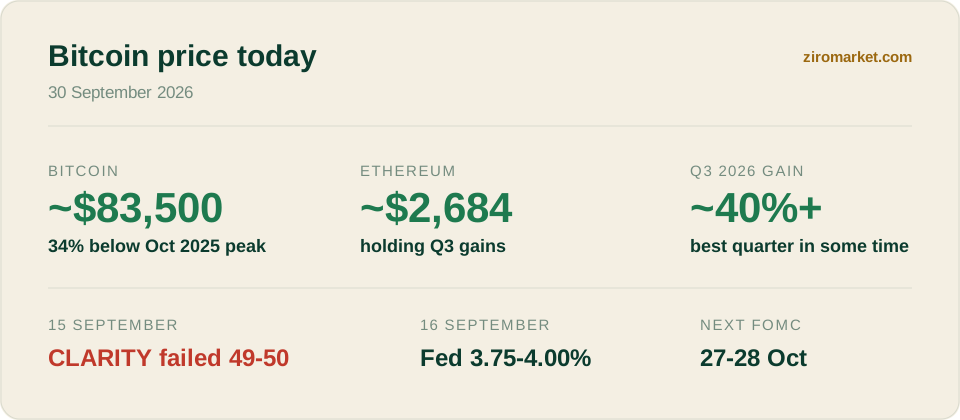
The quarter closed with the rally mostly intact. Bitcoin traded around $83,547 on 30 September 2026, the last day of the third quarter, easing from a peak of $87,265.49 on 23 September but still holding most of a strong Q3 gain. Ethereum traded near $2,684, broadly keeping pace with Bitcoin through the quarter.
The story behind the move has not changed since mid-September. The CLARITY Act failed a Senate procedural vote 49-50 on 15 September 2026, and within 48 hours the Commodity Futures Trading Commission sent two rule proposals to the White House regulatory review office while the Securities and Exchange Commission opened a five-year conditional exemption for qualifying tokenised-stock platforms.
That is the trade the market has kept making through quarter-end. A statute written by Congress would have been cleaner and more durable, but rules written by agencies under existing authority can start moving immediately, and crypto has spent two years pricing the absence of any rules at all.
Why did crypto rise after losing the vote?
Because the question changed from whether rules arrive to who writes them. The CLARITY Act failed 49-50 on 15 September 2026, needing 60 votes to advance, with every Democrat present voting no over unresolved ethics provisions covering presidential crypto profits.
The agencies did not wait. The CFTC sent two proposals, Regulation Crypto Asset Transactions and Regulation Crypto Asset Markets, to the Office of Information and Regulatory Affairs on 18 September 2026, the White House body that reviews federal rules before publication. The contents have not been released.
The SEC moved in parallel. It introduced a five-year conditional exemption for qualifying tokenised-stock platforms, while the CFTC issued no-action relief letting some passive software providers, including certain wallet interfaces, connect users to regulated derivatives markets without registering as introducing brokers.
What the macro is still doing to the price
The rate backdrop has not improved. The Federal Reserve raised its target range to 3.75% to 4.00% on 16 September 2026 and projected a policy rate near 4.1% through 2027, which is the competition an asset paying no yield has to beat.

Energy stopped being a headwind by month end. Brent crude eased from $108.75 to about $97 as Saudi Arabia routed more crude around the Strait of Hormuz, and Indian equities logged their worst September in 25 years, yet Bitcoin held its quarterly gain through both, which is a point in its favour.
Where this sits in the cycle
Context stops the daily move from looking bigger than it is. At about $83,500, Bitcoin is roughly 34% below its all-time high of $126,198 set in October 2025, but well above the $62,000 to $63,000 band it traded in during July 2026, closing out one of its strongest quarters in some time.
Ethereum is the more interesting leg right now. At about $2,684 it has broadly kept pace with Bitcoin through the quarter, a change from the pattern our Ethereum versus Bitcoin piece has tracked all cycle, and the Bitcoin dominance reading is the number that would confirm whether it lasts into Q4.
What to watch
The first is what the CFTC proposals actually say when they clear White House review, because the treatment of spot markets and custody is the difference between a workable framework and another round of litigation.
The second is whether the CLARITY Act returns before the midterms, since a 49-50 vote is a near miss rather than a rejection, and one changed vote plus a fix to the ethics provisions puts it back in play.
The third is the Federal Reserve's 27 to 28 October meeting rather than its last decision, since crypto trades on the expected rate rather than the current one. Our Bitcoin H2 2026 scenarios set out the levels that would confirm a break in either direction into Q4.
Risks to monitor
The second risk is Indian and specific. A flat 30% tax plus cess on gains, no loss set-off and 1% TDS on most transfers mean an Indian holder keeps less of an upswing than the headline suggests, which our crypto tax in India guide explains in full.
The third is positioning. A market that rallied through a legislative defeat, a Fed hike and India's worst equity month in 25 years is reading intent rather than confirmed rules, and the text is still sitting unpublished in a White House review office. This is general information, not investment advice.
The quarter that crypto spent waiting on Congress ended with Congress having done nothing and the price up anyway. That tells you the market had already stopped believing Congress was the only door.