Every five years, China sets the agenda for the global economy. China's National People's Congress formally adopted the 15th Five-Year Plan (2026-2030) in March 2026, articulating a strategy that doubles down on manufacturing and technology leadership while deepening trade with the Global South to reduce dependence on Western markets. Targets include growing digital industries to 12.5% of GDP, maintaining R&D spending growth above 7% annually, and advancing in EVs, AI chips, robotics, and aerospace, sectors where China aims to achieve global dominance by 2030.
The 15th FYP is being executed in the most challenging geopolitical environment China has faced in decades: US tariffs, technology export controls on semiconductors, and a European Union increasingly willing to use trade instruments against Chinese industrial subsidies. The plan's response is to use domestic market scale, Global South trade, and accelerated innovation to create strategic self-sufficiency in the sectors that matter most.
What Happened
China's planning process. The Five-Year Plan drafting began in 2024-2025, incorporating experience from the 14th FYP (2021-2025), which faced significant headwinds from COVID, US chip export controls, and property sector deleveraging. The 15th FYP emerged as a more explicit technology-first document than its predecessors.
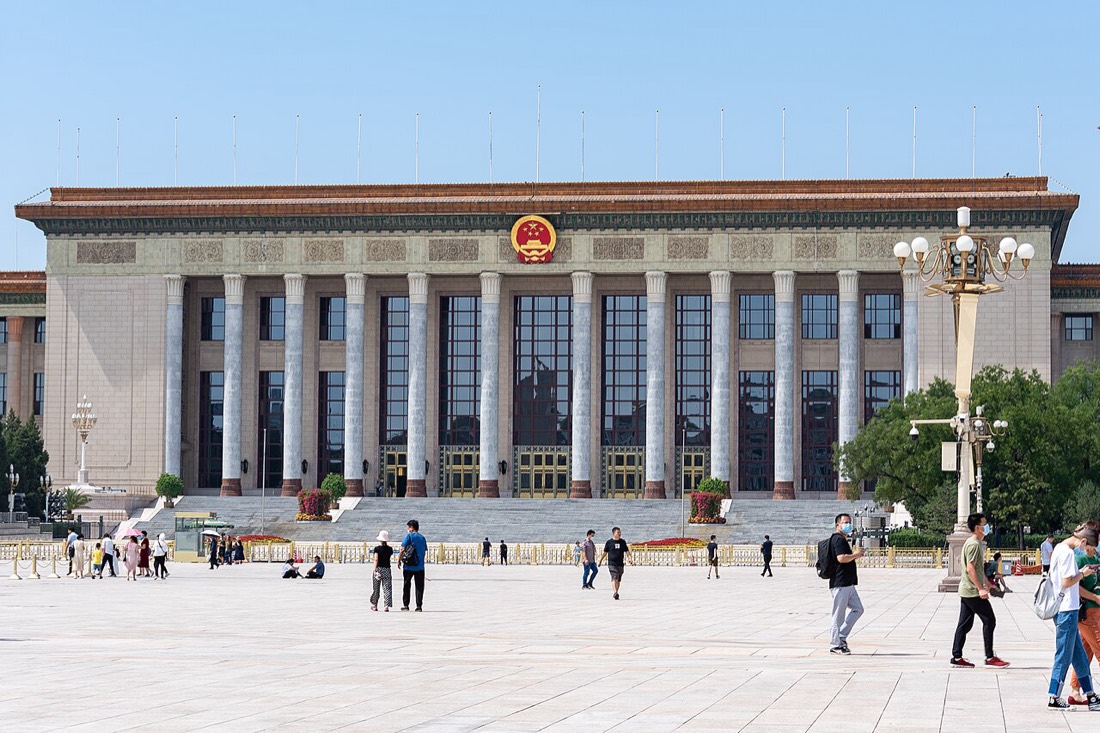
Adoption in March 2026. The NPC adopted the full plan text in March 2026, with the overarching goal of building a "modern industrial system" listed as the first key objective, more explicitly manufacturing and industry-focused than the previous plan's balanced approach.
Digital economy targets, 12.5% of GDP. In 2025, China's digital economy represented approximately 10-11% of GDP. Growing this to 12.5% by 2030 requires approximately 2-3 percentage points of additional digital sector contribution. This will come from AI services, cloud computing, digital manufacturing (smart factories), e-commerce, and the broader data economy. China's digital infrastructure, 5G coverage, data centres, AI computing capacity, is already the world's largest by many metrics.
Manufacturing priority, what changes. The plan explicitly calls for keeping manufacturing at an "appropriate level", a pushback against the natural economic tendency as nations develop to shift from manufacturing to services. Xi Jinping has argued, and the plan reflects, that China must not repeat the mistake of Western nations that hollowed out their manufacturing bases for cheaper services-led growth. Advanced industries as the backbone means: EVs, batteries, solar, semiconductors, aerospace, and industrial robotics must collectively grow faster than the overall economy.
Key sector-specific targets:
Global South strategy. The plan explicitly emphasises deepening Belt and Road Initiative (BRI) engagement with Southeast Asia, Africa, Middle East, and Latin America. CIPS (China's cross-border payment system) settlement increased one-third during the Iran conflict as alternatives to SWIFT were sought. The plan aims to diversify export markets and supply chains away from dependence on Western final demand, reducing the leverage that US-EU tariff policy has on China's growth.
R&D spending above 7% annual growth. China already spends more on R&D in dollar terms than any country except the US. Maintaining 7%+ annual R&D growth ensures China narrows the research quality gap with the US even as US export controls try to slow China's semiconductor and AI progress. Beijing universities and national labs are instructed to prioritise research in areas where Western export controls create dependencies.
Why This Matters for Investors
China at 4.4% growth in 2026 is still growing faster than every G7 economy. The absolute scale is enormous: 4.4% of China's $18 trillion+ economy is approximately $800 billion in new economic output annually, comparable to adding a new South Korea every two years. The 15th FYP's targets, if achieved, will make China an even more formidable competitor and even larger market by 2030.
The EV implication for India is specific. China's BYD, SAIC, and other EV companies are aggressively expanding into new export markets. India currently maintains trade barriers that limit Chinese EV imports (100%+ tariffs on Chinese-origin vehicles). If India-China trade relations normalise and barriers fall, Chinese EVs priced 30-50% below Indian competitors would be a severe competitive threat to Tata, Mahindra, and India's EV manufacturing ambitions. The PLI automotive scheme is designed partly to defend against this.
Solar and battery supply chain. India's rapidly expanding solar capacity is almost entirely dependent on Chinese-manufactured panels and cells. China controls 80% of global solar panel production. Under the 15th FYP's manufacturing dominance strategy, this dependency is likely to persist or deepen. India's PLI for solar manufacturing is attempting to build domestic capacity, but achieving genuine self-sufficiency against China's scale in solar is a multi-decade task.
Technology competition. US export controls on advanced semiconductors (particularly Nvidia AI chips) to China are a defining feature of the 2026 geopolitical picture. The 15th FYP's response is to accelerate domestic semiconductor development through SMIC, Huawei's chip design subsidiaries, and national research programmes. China is investing billions in mature-node semiconductor fabs (28nm, 14nm) where export controls are less binding. Chinese AI companies (Baidu, Alibaba, ByteDance) are developing their own AI models using domestically available chips.
For global supply chains, the 15th FYP's manufacturing-first strategy means China will not withdraw from its role as the world's factory. Companies that moved supply chains out of China in 2022-2024 (post-COVID diversification) are discovering that China + alternatives is more realistic than China replacement. India, Vietnam, Mexico, and Bangladesh have gained manufacturing share but cannot fully substitute China's scale.
Market Reaction
Chinese equities (CSI 300, Hang Seng) have been volatile in 2026, reflecting both domestic economic headwinds (property sector, youth unemployment) and the geopolitical environment. The 15th FYP's industrial policy focus is generally positive for state-owned enterprise (SOE) stocks in sectors designated as strategic priorities (aerospace, semiconductors, EVs).
Foreign investor positioning on China has been cautious. US-listed Chinese ADRs (Alibaba, JD.com, PDD) saw significant outflows in 2024-2026 as regulatory risks and delisting threats kept institutional investors cautious. However, Chinese onshore equities (via Stock Connect) have seen selective inflows from Asian institutional investors who see the 15th FYP's domestic consumption push as a medium-term positive.
India's "China Plus One" beneficiary status has been a key investment thesis for global manufacturing companies building redundancy into their supply chains. The 15th FYP's emphasis on Global South engagement means China is also actively competing to retain manufacturing in Southeast Asia through BRI infrastructure investment, potentially slowing some of the supply chain diversification that benefits India.
What Investors Should Watch
China GDP prints in Q2-Q3 2026. If 4.4% growth holds, it validates the 15th FYP's launch conditions. If growth slips below 4%, it would signal structural challenges (property deleveraging, demographics) that even the plan cannot solve quickly.
US semiconductor export control escalation. The Biden administration imposed aggressive chip export controls in October 2022 and January 2023. The Trump administration has continued and potentially extended these controls. Any further escalation (eg. restrictions on more chip types, equipment, or allied nations) would directly affect China's 15th FYP technology targets and could trigger retaliatory measures affecting global tech supply chains.
Belt and Road engagement in critical minerals. China's BRI investments increasingly target critical minerals (lithium, cobalt, nickel, copper) in Africa and Latin America. These minerals are essential for EVs, batteries, and the green energy transition. China securing dominant access to these supply chains would give it significant leverage in the global green tech economy, an important strategic watch item.
Risks to Monitor
Property sector overhang. China's real estate sector, which represents approximately 25-30% of GDP including upstream and downstream effects, remains in a managed deleveraging. Developer debt restructuring (Evergrande, Country Garden) is not fully resolved. If property prices fall further significantly, household wealth effects could reduce domestic consumption and undermine the plan's consumption-stimulus objectives.
Demographic headwinds. China's population is declining and ageing rapidly. The working-age population peak has passed. The 15th FYP's productivity-through-technology strategy is partly a response to this demographic challenge: automate manufacturing with robots, and grow GDP per worker as the worker count falls.
US-China tech decoupling acceleration. If the US extends export controls to allied nations through mechanisms like the Foreign Direct Product Rule, it could deny China access to semiconductor equipment and design tools from Japan and the Netherlands (ASML), not just from US companies. This would significantly slow China's semiconductor ambitions and create broader geopolitical fragmentation in the technology sector.
China's 15th Five-Year Plan is a declaration of strategic intent: by 2030, China will be the world's undisputed leader in EVs, solar, AI applications, and advanced manufacturing, while simultaneously reducing dependence on Western markets through Global South deepening. Whether the US and EU can deploy trade, investment, and technology policies fast enough to constrain this ambition is the defining geopolitical and economic question of the late 2020s.