India's quick commerce sector reached its most consequential milestone to date in the March 2026 quarter: the largest player, Blinkit, turned adjusted EBITDA positive for the first time. Eternal Limited, the parent company of Zomato and Blinkit, reported Q4 FY26 net profit of Rs 174 crore, a 346% jump from Rs 39 crore a year earlier, as Blinkit delivered an adjusted EBITDA of Rs 37 crore on net order value of Rs 14,386 crore. The results, released on April 28, 2026, resolved the central question investors had been asking about quick commerce in India: can this business model actually make money?
The answer, at Blinkit's scale, is yes. The transition from a Rs 178 crore EBITDA loss to a Rs 37 crore EBITDA profit in one year, against 95% growth in order value, is the kind of inflection point that changes the investment narrative for an entire sector.
Blinkit has since gone further. In Q1 FY27 it booked Rs 15,664 crore of revenue against Rs 3,100 crore for food delivery, though most of that gap is an accounting effect, which our Eternal Q1 FY27 results piece unpacks.
Newer results are available: Eternal has since reported Q1 FY27, where Blinkit's revenue overtook food delivery several times over on a 1P accounting change that most coverage missed. See our Eternal Q1 FY27 breakdown. This page covers the Q4 FY26 quarter in which Blinkit first turned profitable.
What Happened
Eternal's Q4 FY26 results were released on April 28, 2026. The company has now fully integrated Blinkit's results into its consolidated reporting, which is why the revenue number of Rs 17,292 crore looks dramatically larger than the Rs 5,833 crore of a year ago. The prior-year revenue is not fully comparable due to changes in how gross order value is reflected versus net revenue in Eternal's accounts post the Blinkit full consolidation.
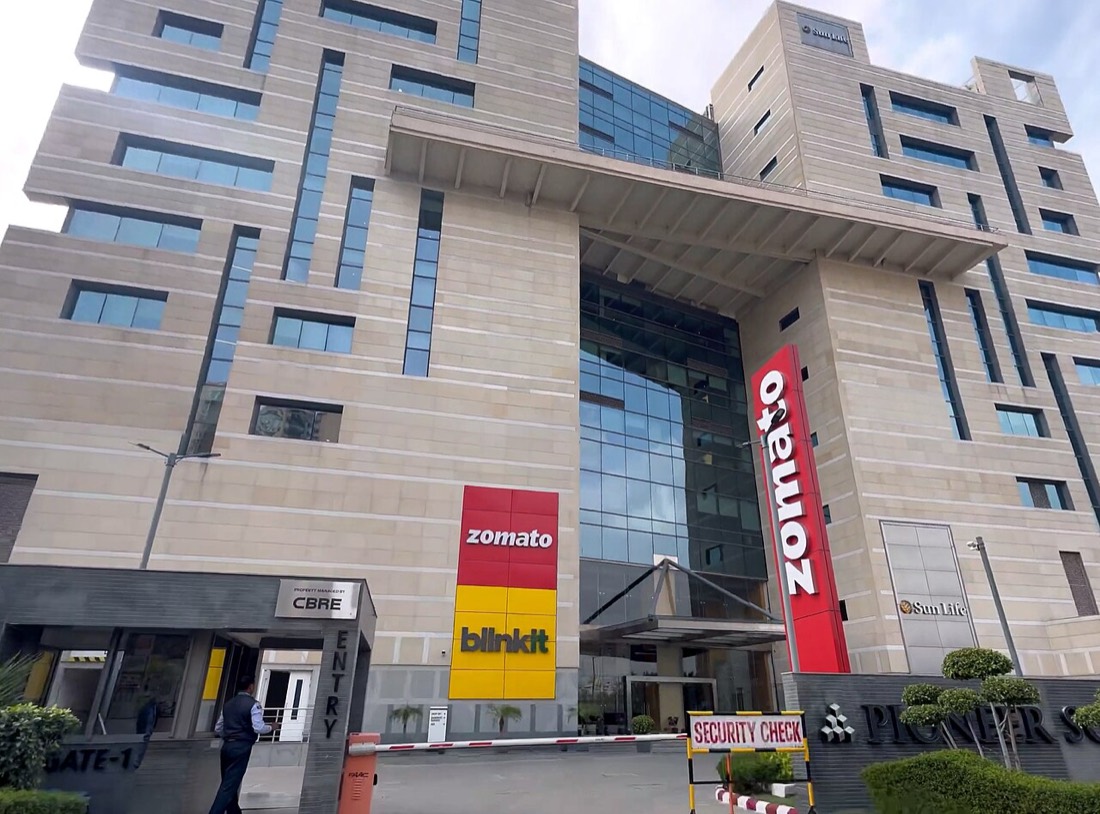
Blinkit's Q4 FY26 numbers are the story of the quarter:
Net Order Value of Rs 14,386 crore (up 95% YoY). Adjusted EBITDA of Rs 37 crore (vs Rs 178 crore loss in Q4 FY25). 2,243 dark stores operational as of March 31, 2026. 273.9 million orders processed in the quarter. 27.2 million monthly transacting customers.
The dark store count of 2,243 is now the largest quick commerce store network in India. The company added 216 net new stores in Q4 alone, maintaining an expansion pace of roughly 70+ stores per month. Each new Blinkit dark store costs approximately Rs 30 to 50 lakh to set up and takes 3 to 6 months to reach mature order density. The EBITDA profit at the company level, with such a large portion of the network still ramping, suggests that mature stores are significantly profitable and subsidising the ramp-up cost of newer stores.
Zomato food delivery:
NOV of Rs 9,757 crore (up 18.8% YoY), adjusted revenue Rs 3,125 crore (up 29.7%). The food delivery business is not growing as fast as Blinkit but is consistently profitable and generates the operating cash flow that funds Blinkit's expansion.
Management guided Blinkit's NOV to grow at 60%+ CAGR over the next three years, driven by geographic expansion into more cities, assortment expansion into categories beyond groceries, and order density improvement in existing markets.
Why This Matters for Investors
Blinkit's EBITDA positivity is the proof point that redefines how quick commerce should be valued. Before this quarter, investors valued quick commerce businesses at a discount because of the uncertainty about whether the model would ever generate profits. Delivery economics, the cost of a rider delivering an order, are difficult to reduce below a certain floor. Dark store fixed costs, including rent, staff, and inventory write-offs, require high order volumes to be covered.
Blinkit clearing the EBITDA breakeven threshold while still rapidly expanding its store count suggests its unit economics are superior to what investors feared. A dark store network delivering 273 million orders in a single quarter, averaging approximately 121,000 orders per store per quarter or 1,300 orders per store per day, is approaching the density levels that justify the fixed cost base.
The contrast with Swiggy Instamart is now stark. Instamart reported approximately Rs 858 crore in losses in the comparable period, while Blinkit was profitable. Same sector, different execution outcomes. This gap validates Zomato/Eternal management's bet on Blinkit as a standalone, scaled quick commerce network rather than a food delivery bolt-on.
For Zepto, which is pursuing an IPO at a $5.6 to $5.95 billion valuation, Blinkit's profitability is a double-edged competitive data point. It proves the quick commerce model works at scale, which supports Zepto's investment thesis. But it also shows Blinkit pulling ahead operationally, which creates a question about the competitive intensity of the duopoly Zepto must contend with post-IPO.
Market Reaction
Eternal's stock rose sharply following the Q4 results release on April 28, 2026. The combination of 4.5x profit growth, Blinkit's EBITDA breakeven, and confident guidance on 60%+ NOV growth for Blinkit was received enthusiastically by institutional investors who had been waiting for this proof point.
Analyst target price upgrades for Eternal followed the results. The narrative shift from "will Blinkit ever make money" to "how valuable is a profitable and growing Blinkit" is a qualitative change in the stock's risk profile. A profitable and growing quick commerce business embedded in a food delivery platform with 27+ million active customers is a substantially more valuable entity than it was a year ago.
Eternal has also been renamed from Zomato Limited to Eternal Limited to reflect that the company is now more than a food delivery app: it operates Blinkit, District (its business services platform), and potentially other verticals.
What Investors Should Watch
The Q1 FY27 results in July 2026 will show whether Blinkit's EBITDA profitability is sustained and improving. Q4 (January to March) typically has favourable conditions for quick commerce as winter and year-end buying patterns drive higher order values. Q1 (April to June) is a tougher summer season. Whether Blinkit stays EBITDA positive through a seasonally softer quarter is the durability test.
Dark store addition pace will indicate whether Eternal is accelerating geographic expansion or being selective. A 60%+ NOV CAGR over three years requires both store count growth and order density improvement. If Eternal is adding 200+ stores per quarter consistently, it is on the expansion path.
District, Eternal's B2B business services segment, is a less-discussed part of the business but could become significant as the company expands beyond consumer delivery.
Risks to Monitor
Blinkit's adjusted EBITDA excludes certain corporate-level costs. The Rs 37 crore profit is not a net profit. At the net profit level after all allocations, Blinkit may still be loss-making in some definitions. Investors should examine Eternal's detailed segment disclosures to understand the full profit picture rather than relying on adjusted EBITDA alone.
The store expansion is capital-intensive and requires continued investment. At 216 new stores in Q4 alone, capex requirements are significant. If the expansion pace accelerates as guided, Eternal will need either strong internal cash generation or external fundraising to finance the network buildout.
Competition from Zepto, which is using its IPO proceeds to expand aggressively, and from Swiggy Instamart, which is still investing heavily despite losses, means Blinkit cannot ease its investment pace without risking market share loss. The profitability Blinkit has achieved may be partially reinvested back into competitive pricing and promotions rather than flowing to the bottom line, especially as Zepto deploys IPO capital.
Blinkit delivering 3 million orders per day is India's quick commerce sector's most visible milestone. The sector has moved from a concept to a profitable, scaled reality faster than most analysts expected. The next question is whether profitability deepens at existing stores as the network matures, or whether competitive reinvestment keeps margins thin.