Options look like a cheap way to bet on the Nifty, and that is exactly why so many people lose money on them. A call option is the right to buy an asset at a fixed strike price by an expiry date, and a put option is the right to sell it, and in both cases the buyer pays an upfront premium that the seller keeps if the market does not cooperate. This is a mechanics guide, not a recommendation to trade.
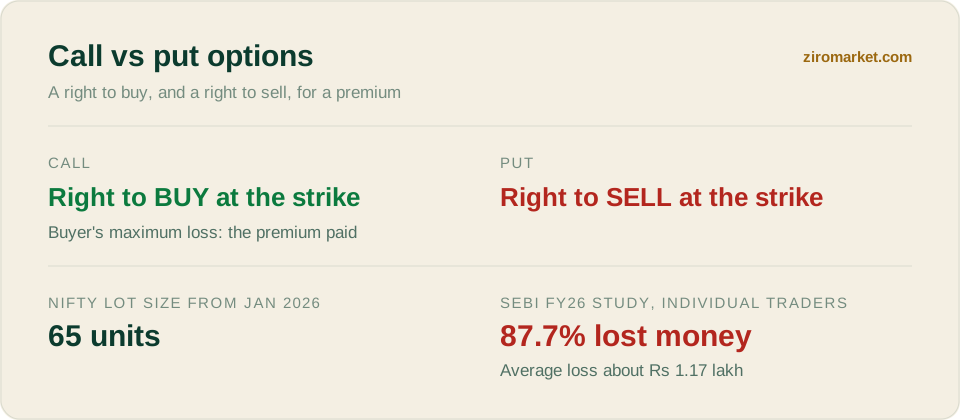
What is the difference between a call and a put?
The two contracts are mirror images, and which one you want depends on what you expect the Nifty to do. The table sets out the basics.
What does one Nifty option contract cost?
Take the Nifty at about 22,422, where it closed on 1 October 2026. One lot of 65 means each point of premium costs you Rs 65, so a premium of Rs 120 on a 22,500 call costs Rs 7,800 to buy. The numbers below are illustrative, not live prices.
The contract controls about Rs 14.6 lakh of the index (22,422 times 65), so a small premium can swing sharply in either direction. Index options settle in cash, so no shares ever change hands.
Why can you be right and still lose?
An option has a built-in expiry clock, so the market has to move far enough and fast enough to cover the premium before time runs out. That erosion, called time decay, speeds up as expiry nears. Nifty weekly contracts expire every Tuesday as of July 2026, which compresses the clock to days. A direction call that is correct but slow still loses money.
What did SEBI change, and what does trading cost now?
SEBI's October 2024 package made index options bigger-ticket contracts and tightened the rules around expiry. Index derivative contracts must now be worth at least Rs 15 lakh, with lot sizes set so the value sits between Rs 15 lakh and Rs 20 lakh at each review, and weekly expiries are limited to one benchmark index per exchange. Buyers must pay the full premium upfront, a rule in force since 1 February 2025.
The tax cost rose too. From 1 April 2026, securities transaction tax on options premium went to 0.15% from 0.1%, and on futures to 0.05% from 0.02%. Every round trip now starts a little further behind, which matters most to people who trade often for small gains.
Why do most F&O traders lose money?
SEBI's study released in August 2026 found 87.7% of individual traders lost money in equity derivatives in FY26, with combined net losses of about Rs 91,685 crore. That is better than the roughly 91% in FY25 and the 93% across FY22 to FY24, but the average loss still rose to about Rs 1.17 lakh per trader. Active traders fell about 20%, from 98.1 lakh to 78.6 lakh.
Time decay, transaction costs, taxes and over-sized positions all work against the buyer. Options accounted for about 92% of the aggregate losses, and among traders who lost money two years running and kept trading, about 90% lost again the following year. For how traders read crowd positioning and where that goes wrong, see open interest and put-call ratio, and for what the market's own fear gauge says, see what the India VIX measures.
The next test is whether the 78.6 lakh traders who remain keep shrinking in FY27 now that the higher tax is in force for a full year.