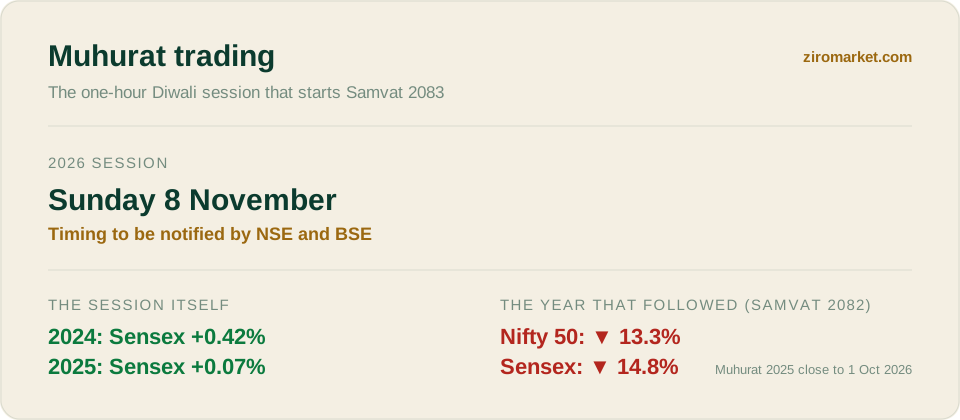
Every autumn the same question lands in search boxes: is the market open on Diwali? Yes, in a limited way: NSE and BSE hold a one-hour Muhurat trading session on Sunday 8 November 2026 to mark Diwali Laxmi Pujan and the start of Samvat 2083, but the exchanges have not yet notified the exact timings. Tuesday 10 November is a full trading holiday for Diwali Balipratipada.
What time is Muhurat trading in 2026?
Nobody can say yet, because the exchanges publish the slot by circular close to the date and it moves from year to year. The window follows the Laxmi Pujan muhurat, an auspicious time chosen by the calendar, not by market convenience.
Why does a one-hour session exist?
Diwali is the start of the Hindu accounting year, called Samvat. Traders have long opened a fresh set of books on Diwali evening with Chopda Pujan, the worship of Goddess Laxmi and the ledgers, and the exchanges built a trading session around that ritual. BSE began the tradition in 1957, and NSE adopted it in 1992.
Does Muhurat trading predict how the year will go?
It tends to be green, and that is about all. The 2024 session was the seventh Muhurat close in a row in the green, and the 2025 session extended the run with a gain of 25 points on the Nifty. One tally covering the last decade or so found only 2016 (down 0.14%) and 2017 (down 0.63%) as losing years for the Nifty, with typical gains between 0.4% and 0.9%. Tallies differ slightly by source.
The pattern is a ritual effect, not a signal. Samvat 2082 is the clearest counterexample: the Nifty closed Muhurat 2025 at 25,869 and stood at 22,422 on 1 October 2026, which is 13.3% lower. The Sensex went from 84,426 to 71,910 over the same stretch, a fall of 14.8%.
What is Samvat, and how is it different from the financial year?
Samvat is the Vikram Samvat calendar, which runs 57 years ahead of the Gregorian one, so the year starting on Diwali 2026 is Samvat 2083. Samvat is a traders' calendar, while companies, the taxman and your tax return all run on the April to March financial year, which is FY27 right now. That is why every Diwali season brings a round of "Samvat returns" headlines that measure the Nifty from one Diwali to the next.
Those headlines are a convenient yardstick, nothing more. The Samvat 2082 number is not final until the year closes on Diwali 2026, and it moves with every trading day until then. A figure drawn between two festival dates also depends heavily on where the market happened to sit on each of those two days.
Can you trade normally during Muhurat trading?
Yes. The exchanges open a one-hour normal market where regular orders through your broker go through, usually preceded by a short pre-open session. Because the session is brief and symbolic, price moves tend to be small, and your broker's margin rules and the exchange's price bands apply just as on any other day. The useful preparation is practical: note the circular, check your broker app for any product restrictions, and remember that this year's session falls on a Sunday.
Nothing about the session changes how a share is valued. A company's fundamentals and the broader trend decide whether a position works, not the hour it was bought, and the India VIX is a better gauge of nerves than any ritual. None of this is investment advice.
Gold buyers face their own Diwali calendar, covered in should you buy gold this festive season. The wider setup heading into November matters more than the ceremony, and the October 2026 market outlook lays it out.
This page will be updated in place once NSE and BSE publish the 2026 timing circular.