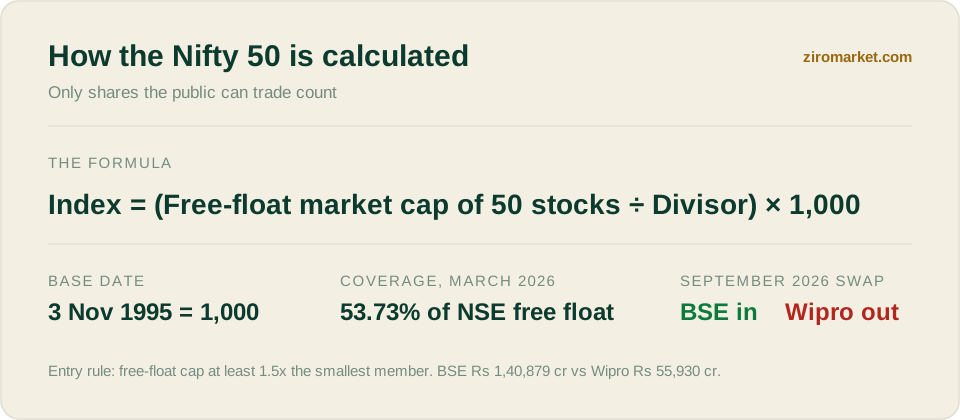
Open any market app and the Nifty 50 is the first number you see, yet few people know what produces it. The Nifty 50 is the total free-float market capitalisation of its 50 stocks, divided by an index divisor and multiplied by the base value of 1,000 set on 3 November 1995, so only shares the public can actually trade count towards the level. The formula is simple, and the rules around it decide which companies get a vote.
What is the formula behind the Nifty 50?
Take each stock's price, multiply by its share count, then multiply by the fraction of shares free to trade. That fraction, called the investible weight factor, is what separates free-float market capitalisation from the headline market cap you read in news stories. Add the 50 results, divide by the divisor, multiply by 1,000, and you have the level.
The divisor is the quiet hero. It is adjusted whenever a stock enters or leaves the index or a rights issue changes share counts, so those events never move the index on their own. Only price changes do. This is why the index level stays comparable across decades even though the companies inside it keep changing.
Why does free float matter more than size?
A company can be enormous and still have most of its shares locked up with its founders or the government. Counting those locked shares would let a stock sway the index more than the shares actually available to buy and sell justify. NSE Indices has used free-float weighting for the Nifty since June 2009, and what market cap really measures explains why size and tradable stake differ.
Who gets into the Nifty 50, and who gets out?
NSE Indices runs a rules-based review twice a year, using six-month averages to 31 January and 31 July. A stock must be eligible for futures and options, trade without gaps over six months, and keep its impact cost at or below 0.50% for 90% of observations on a Rs 10 crore order. Then the survivors are ranked by average free-float market capitalisation.
The 1.5x buffer is deliberate, because it stops a stock hovering near the cut-off from being added and dropped every six months. It also explains the biggest surprise of the latest review.
How did BSE replace Wipro in September 2026?
NSE Indices announced on 10 August 2026 that BSE Ltd would replace Wipro after the close on 29 September. BSE's six-month average free-float market cap was Rs 1,40,879 crore against Wipro's Rs 55,930 crore, comfortably above the 1.5x line. Wipro shifted to the Nifty Next 50.
The runners-up show how tight the rule is. TVS Motor (Rs 84,566 crore) and Divi's Laboratories (Rs 82,930 crore) were both larger than Wipro but fell short, because the smallest members left after Wipro's exit were HDFC Life Insurance and Tata Consumer Products, and neither candidate cleared 1.5 times their size. BSE shares had risen about 20% in 2026 while Wipro had fallen about 40%, as of 29 September 2026. Wipro's year also included a Rs 15,000 crore buyback.
What does the Nifty 50 leave out?
The headline Nifty is a price index, so it ignores dividends, which are captured only by the separate Nifty 50 Total Returns Index. Over long periods the gap is meaningful, which matters if you compare it with a mutual fund's returns. The 50 stocks also covered about 53.73% of NSE-listed free-float market capitalisation as of 30 March 2026, so the index is a large slice of the market and not all of it.
If you track the Nifty to see where foreign and domestic institutions are pushing money, remember that every index fund tracking it had to make the same swap on the same day.
The next review is due in March 2027, and the stocks to watch are the ones sitting just outside the line.