Few Indian companies have fallen as far and climbed back as much as this one. Paytm went from hyped IPO to near-collapse when the RBI shut its payments bank in early 2024, and in 2026 it is profitable again, with the stock recovered sharply from its lows, leaving investors asking whether the comeback is real or still fragile. It is one of the market's most dramatic turnaround stories.
The company that helped make digital payments mainstream in India had to reinvent itself to survive. Whether that reinvention is durable is the question hanging over the stock.
The Fall
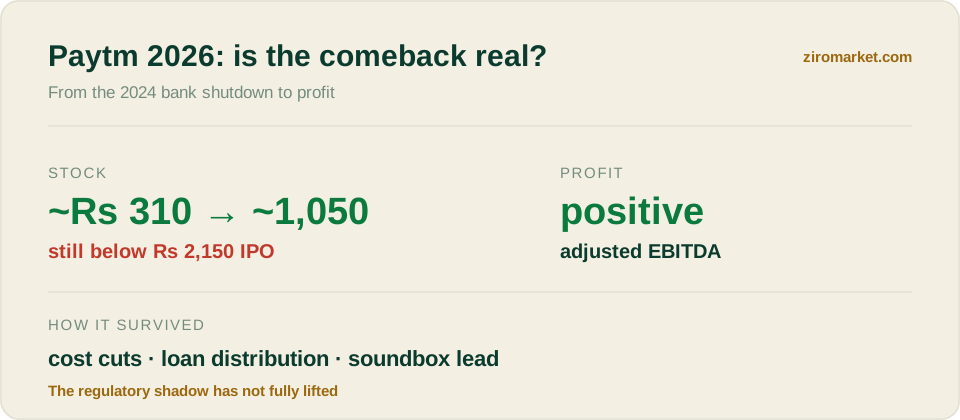
The crisis was existential. In January 2024 the RBI ordered Paytm Payments Bank to stop taking new deposits over persistent compliance issues, effectively winding down the banking arm and shaking Paytm's core payments business and its reputation. The stock, already well below its 2021 IPO price of Rs 2,150, tumbled toward Rs 310.
The damage went beyond the share price. Paytm had to migrate its wallet and banking relationships to other banks, reassure merchants and users, and rebuild trust with regulators, all while its losses drew scrutiny. For a while, the question was not how fast Paytm could grow but whether it could stabilise at all.

The Comeback
Paytm answered by shrinking to strength. It cut costs hard, exited or paused unprofitable lines, and shifted from lending itself to distributing loans for partner banks, which lowered both regulatory and credit risk. The result was a return to positive adjusted EBITDA and a path toward consistent net profit, on revenue around Rs 8,500 crore.
The payments engine held up. Paytm's merchant network, and its lead in payment devices like soundboxes, kept it central to Indian retail payments even after the bank episode. That distribution is what gives it a base to sell financial products on top of.
The stock followed the fundamentals. From its 2024 lows near Rs 310, it recovered to around Rs 1,347 by late July 2026 and reached a more-than-four-year high in August, roughly 52% above its March 2026 low, a rebound that still leaves it far below the IPO price and is a reminder of how much value the crisis destroyed.
What the latest quarter actually shows
The comeback stopped being a narrative and became an income statement. In Q1 FY27, the quarter ended June 2026, Paytm reported revenue from operations of Rs 2,448 crore, up 27.6% year on year, and profit after tax of Rs 220 crore, up 78.9%.
The margin line is the part that matters more than the headline profit. EBITDA margin reached 8.29%, against 3.75% in Q1 FY26 and 5.83% in Q4 FY26, which is the shape of a business where cost discipline is compounding rather than a single good quarter. Management has guided FY27 revenue growth above the 22% delivered in FY26, and several brokerages lifted targets by roughly 30% after the print.
One detail cut the other way, and it is worth knowing because it explains a share-price wobble that had nothing to do with operations. The board shelved a proposed bonus issue, and the stock fell about 3% on the day despite the strong numbers. A company that has spent two years rebuilding credibility gets punished for withdrawn expectations more than most.
What Still Worries Investors
The comeback is real but not bulletproof. Here is the balance.
Why This Matters for Investors
Paytm is a case study in fintech resilience. It shows that a new-age company can survive a near-death regulatory blow by cutting costs and changing its model, but also how long and painful that recovery is, a lesson that colours how the market prices regulatory risk across fintech, from PhonePe to Groww.
It is also a widely held, widely used stock, which makes it a sentiment bellwether for the whole new-age space. A durable Paytm recovery would signal that even the hardest-hit fintechs can find their footing, while a relapse would revive doubts about the sector's regulatory fragility.
The turnaround also carries a lesson about UPI economics that runs across fintech. Paytm, like PhonePe, cannot charge for the UPI payments that made it a household name, so its profit has to come from lending distribution, payment devices and financial services layered on top of that free traffic. Rebuilding those higher-margin lines after the bank shock is exactly what the recovery has been about, and it is why the merchant relationships Paytm held onto through the crisis matter so much: they are the base everything else is sold on.
For investors, the story is now about sustainability rather than survival. The company has proven it can make money in its leaner form; the open question is whether it can grow that profit in a fiercely competitive payments market without another regulatory setback.
Risks to Monitor
The clearest risk is regulation. Paytm operates in a tightly governed space, and any new action on payments or lending distribution would hit hard given its history.
A second risk is competition. PhonePe and Google Pay dominate UPI, which pressures Paytm's payments growth and pricing power.
The third is the lending-partner model. Because Paytm now distributes rather than lends, its financial-services revenue depends on partners' appetite, which can shift with the credit cycle. This is not a recommendation to buy or sell. This is general information, not investment advice.
Paytm in 2026 is a company that stared at collapse and walked back from it, leaner and, for now, profitable. The comeback is genuine, but it was bought with hard cuts and a humbler model, and the regulatory shadow that nearly ended it has not fully lifted. Whether this is the start of a durable second act or a fragile pause is the question its shareholders are still living with.
For the other new-age Indian names at a similar inflection point, see our Nykaa 2026 analysis of the one that has been profitable all along, and the Eternal Q1 FY27 breakdown of Blinkit overtaking food delivery.