By the time an IPO opens for your application, the pricing decision has already been made. The price band is fixed days before public bidding, using demand feedback gathered privately from institutions, and SEBI requires the cap to be no more than 120% of the floor. Everything the retail investor sees afterwards is a demand tally, not a price negotiation.
The National Stock Exchange fixed its band at Rs 1,700 to Rs 1,785 per share on 11 September 2026, a spread of about 5%, which is a narrow band by Indian standards and a signal in itself.
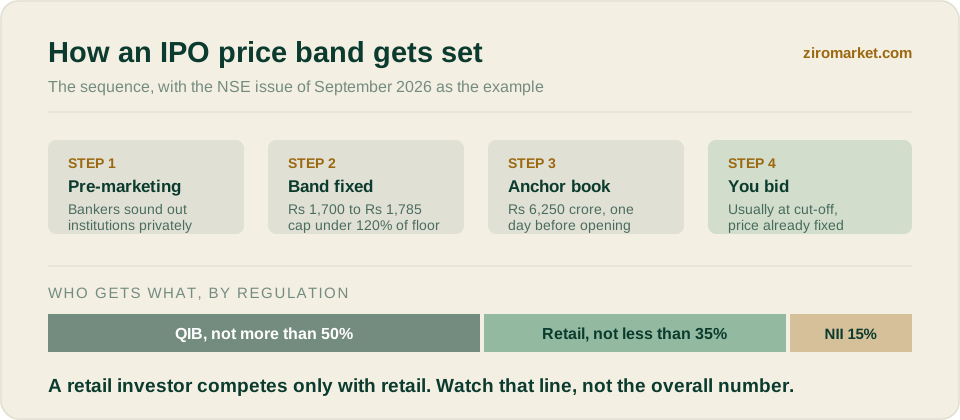
Step one: the band comes from institutions, not the company
Merchant bankers run a pre-marketing exercise, sounding out large investors on how many shares they would take and at what price. That feedback, set against comparable listed companies and the issuer's own numbers, produces the floor and the cap.

The comparison NSE faced shows how the anchor of "comparable" works. NSE unlisted shares changed hands around Rs 1,920 to Rs 1,925 in August 2026 and the band was then fixed below that, at Rs 1,700 to Rs 1,785, against FY26 earnings per share of about Rs 41.62, which puts the upper band near 43 times earnings.
Step two: anchor investors bid a day early
Anchor investors are institutions allotted shares one working day before the public issue opens, at a price inside the band, with a lock-in attached. The book is published that evening.
This is the first public, hard number in the entire process. NSE's anchor book raised Rs 6,746.18 crore from 189 investors on 16 September 2026, every share at the Rs 1,785 top of the band, with 98 mutual fund schemes, 27 life insurers and sovereign funds including GIC, the Abu Dhabi Investment Authority and Norges Bank. Anchors all paying the cap is the institutional way of saying the band was not too high.
Up to 60% of the qualified institutional buyer portion may go to anchors on a discretionary basis, with one-third of that reserved for domestic mutual funds, which is why the anchor list reads as a who's who rather than a proportionate allotment. Our anchor investors explainer covers what their presence does and does not prove.
Step three: the categories, and who competes with whom
Allocation is fixed by regulation before a single bid arrives.
A retail investor competes only with other retail investors, which is why the retail subscription figure matters more to an individual than the overall number. NSE shows why: it closed on 21 September 2026 at 5.7 times overall, with QIBs at 12.7 times and non-institutional investors at 6.5 times, but retail at only about 1.3 times, so a retail applicant's odds were far better than the headline suggested.
Step four: cut-off, and why almost everyone uses it
Only retail individual investors and employees can bid at cut-off, which means accepting whatever final price is discovered within the band. The alternative is naming a price, and a bid below the final price is simply rejected with the blocked money released.
That asymmetry explains the behaviour. Bidding at cut-off costs nothing and removes the risk of being excluded by a few rupees, which is why it is the default choice for most retail applications, as our how to apply for an IPO guide sets out.
What the grey market is, and is not
The grey market premium is the one number retail investors watch most and the one with the least standing. NSE's premium fell from about Rs 227 per share on 11 September 2026 to roughly Rs 48 on the final day, cutting the indicated listing gain from around 12.7% to under 3%, even as the subscription book went from 0.42 times to 5.7 times.
Two indicators moving in opposite directions is the normal state of an IPO, not an anomaly, because subscription measures how many shares people want at a fixed price while the grey market guesses what they will pay afterwards. Our GMP explainer sets out why the direction of the move carries more information than the level.
The part that decides returns
None of the mechanics answer the only question that matters, which is whether the band was set below what the business is worth. The band is an agreement between a seller who wants the highest defensible price and bankers who want a successful listing, and the retail investor arrives after that agreement is complete.
That is not a conspiracy. It is simply the sequence. Reading the anchor book, the width of the band and the retail subscription number is how you work out what the people who were in the room concluded, before deciding whether to agree with them. This is general information, not investment advice.