Two unrelated Indian companies did versions of the same thing within months of each other in 2026, and neither made a single shareholder a rupee richer on day one. LIC's board approved a 1:1 bonus issue on 13 April 2026, its first since listing, while BLS E-Services carried out a 1:2 stock split with a record date of 6 October 2026, and both actions simply redrew how each company's existing value is divided into shares, not how much value exists.
That distinction, between dividing a pie differently and baking a bigger pie, is the one thing worth understanding properly, because the mechanics look identical to a new investor and the economics are completely different from what a windfall feels like.
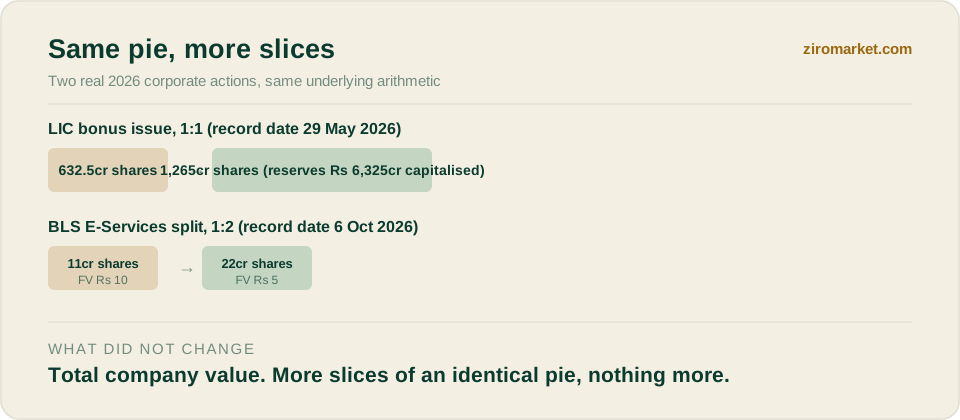
What actually happens in each case
A stock split takes each existing share and divides it into more shares of a proportionally lower face value, the nominal value printed on the share certificate that has nothing to do with the market price. BLS E-Services' 1:2 split cut its face value from Rs 10 to Rs 5 per share and doubled its outstanding share count from 11 crore to 22 crore, a mechanical move that uses money already sitting in the company's share capital account, so that account's total size does not change.
A bonus issue instead creates brand new shares by capitalising free reserves, money the company has already earned and kept rather than distributed. LIC's 1:1 bonus moved Rs 6,325 crore out of reserves and into share capital, which rose from about Rs 6,325 crore to about Rs 12,650 crore, and its outstanding shares roughly doubled from about 632.5 crore to about 1,265 crore.

Why the price adjustment is not a loss
The market price adjusts down in exact proportion to the new share count on the record date, which is a mechanical exchange action, not a crash. If a company worth Rs 2 lakh crore has 100 crore shares at Rs 2,000 each and does a 1:1 bonus, it still has a Rs 2 lakh crore company, now divided across 200 crore shares at roughly Rs 1,000 each. A shareholder who owned 100 shares worth Rs 2,00,000 before the bonus owns 200 shares worth the same Rs 2,00,000 the moment trading resumes.
This is also exactly why a split or bonus is not, by itself, a reason to buy a stock. Nothing about the company's revenue, order book or competitive position changed between the day before and the day after. What has changed is the stock's accessibility: a share that traded at a price many retail investors found intimidating now trades at a fraction of that, which can widen the pool of buyers and lift trading volume, the practical reason most companies cite when they announce either action.
The one place real money does change hands
The exception worth knowing is dividends, where the per-share rate matters after a split or bonus, not before it. A company paying Rs 10 per share in dividends before a 1:1 bonus that continues paying even Rs 6 per share afterward has actually raised its total payout, since the shareholder now holds twice as many shares. This is precisely why our face value and dividend yield explainers matter here: a falling per-share dividend number can still mean a rising total payout, and the only way to tell is to multiply by the new share count.
The accounting distinction also decides what each company can do again later. A split can be reversed through a reverse split, consolidating shares back into fewer, higher-priced ones, something Indian companies rarely do, while a bonus permanently converts reserves into share capital with no mechanism to undo it. For long-term holders, what matters is simpler than the mechanics: check whether a company's revenue and profit are actually growing before and after the action, exactly as you would any other day, because the stock split or bonus changed none of that arithmetic.
Retail investors chasing a lower sticker price sometimes read a split or bonus as the market getting cheaper. It did not. The same company, the same business, the same total value, just cut into more pieces for more hands to hold, the same way LIC's roughly 632.5 crore shares becoming 1,265 crore shares changed nothing about how much insurance premium it collects next year. The mirror-image corporate action, where a company retires shares instead of creating them, is a buyback, worth understanding for exactly the same reason: neither one changes what the business is actually worth.