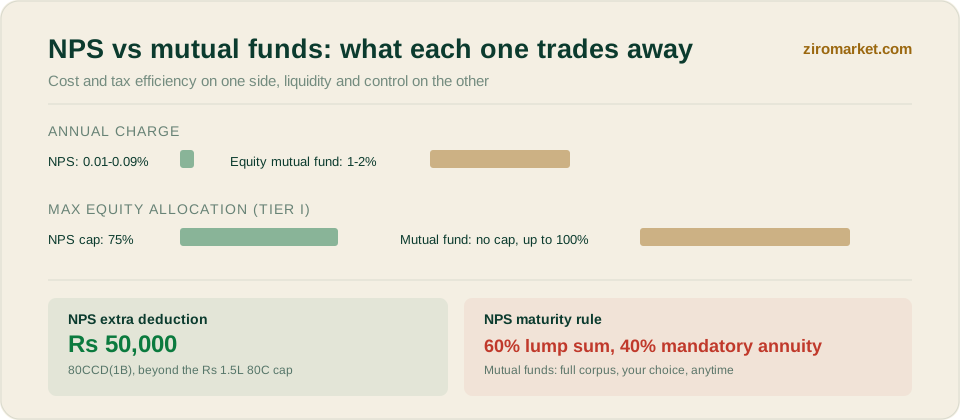
The two most common answers to "NPS or mutual funds for retirement" are both incomplete, because the honest comparison is not about which grows money faster. NPS charges some of the lowest fund management fees in the world, as low as 0.01% to 0.09% a year against a typical 1% to 2% for an actively managed equity mutual fund, and adds a tax deduction mutual funds simply cannot offer, but it locks your money until age 60 and forces part of it into a pension you cannot opt out of. That trade, cost and tax efficiency against liquidity and control, is the actual decision.
What each product actually costs you
The cost gap is the starkest, least talked-about difference between the two. NPS fund managers are permitted to charge as little as 0.01% to 0.09% of assets a year, a structure built for scale rather than individual profit, since the scheme was designed as low-cost retirement infrastructure for an entire country rather than a product sold for margin. An actively managed equity mutual fund typically charges 1% to 2% a year in its regular plan, with direct plans somewhat lower, a difference that compounds meaningfully over a multi-decade retirement horizon, as our index funds vs active funds piece covers from the mutual-fund side alone.
The tax benefit that survives even the new regime
NPS carries a deduction structure mutual funds cannot replicate, and part of it still works under the new tax regime, where almost every other deduction has been stripped out. Your own NPS contribution earns an extra Rs 50,000 deduction under Section 80CCD(1B), on top of the Rs 1.5 lakh Section 80C ceiling that ELSS funds and other tax-saving instruments compete for, as our old vs new tax regime guide details.
Separately, and more valuable for salaried employees, any employer contribution to your NPS account is deductible under Section 80CCD(2) up to 14% of basic salary plus dearness allowance, a limit that now applies equally whether an employer is a government body or a private company, and this deduction is available under both the old and the new tax regime. For someone whose employer offers an NPS contribution as part of salary structuring, this is effectively free tax-sheltered retirement saving, something no equity mutual fund investment can match regardless of which regime an investor chooses.
What happens when the money actually matures
NPS forces a structural choice mutual funds never ask you to make. At 60, a subscriber can withdraw up to 60% of the accumulated corpus as a tax-free lump sum, but the remaining 40% must compulsorily purchase an annuity, a regular pension payment that is itself taxed as income when received every year afterward. A mutual fund investor retiring with an equivalent corpus faces none of this: the entire amount can be withdrawn in one transaction, spread across several years to manage capital gains tax, or simply left invested, following the same capital gains rules as any other equity redemption.
Annuity returns have historically run lower than what a well-run equity portfolio could deliver over the same period, which is the quiet cost buried inside that mandatory 40%, even though the annuity itself does provide something a pure mutual fund portfolio cannot: a guaranteed income stream that cannot be outlived or mismanaged after the fact, a genuine behavioural safeguard for someone who might otherwise spend a lump sum too quickly.
The practical answer most fee-only planners land on is not a choice between the two at all. Using NPS specifically for the amount that captures the full Rs 50,000 extra deduction and any employer match, then running a separate equity mutual fund SIP for everything beyond that, captures NPS's unmatched cost and tax efficiency on a defined slice of savings while keeping the rest liquid and fully under your own control, exactly the kind of layered approach our how to choose a mutual fund guide assumes as the starting point for the mutual-fund portion of any such plan, run as a monthly SIP for the same rupee cost averaging reasons that make a SIP the natural default for a goal decades away.