Most people pick a tax regime by asking which one sounds better. The correct question is a single number: what do your total deductions add up to, and is that number large enough to beat a Rs 75,000 standard deduction plus much lower slab rates?
The new regime is the default for FY 2026-27, and Budget 2026 changed none of its rates. That leaves the same structure Budget 2025 introduced, and the same decision facing everyone who files. One thing did change underneath: the Income-tax Act, 2025 replaced the 1961 law from 1 April 2026 and renumbered most sections, but this piece keeps the familiar labels like 80C and 80D because that is still how the deductions are known.
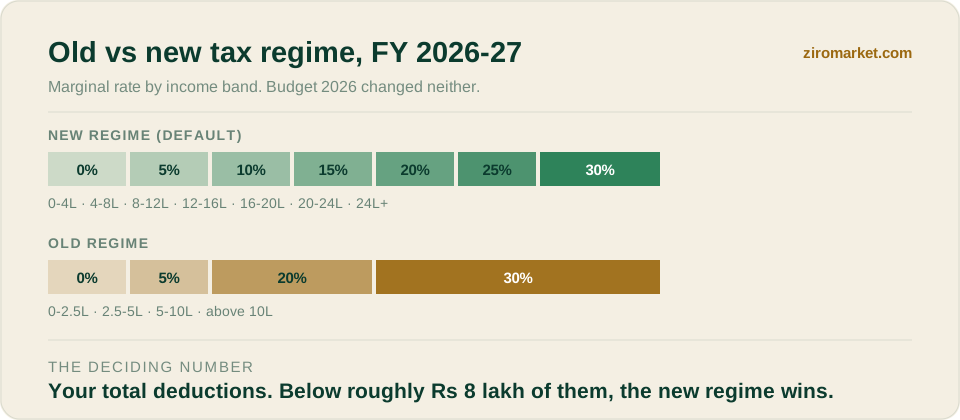
The two structures, side by side
The slabs are not comparable line for line, which is the source of most confusion. The new regime spreads seven slabs across Rs 4 lakh to Rs 24 lakh, while the old regime reaches its 30% rate at Rs 10 lakh.
Standard deduction is Rs 75,000 under the new regime against Rs 50,000 under the old one, and senior citizens get relaxed old-regime entry points of Rs 3 lakh, rising to Rs 5 lakh for the super senior category. Central government employees weighing the same choice should also see what the 8th Pay Commission could do to their pay.

What the new regime takes away
Nearly everything people think of as tax planning. Section 80C, the Rs 1.5 lakh bucket covering EPF, PPF, ELSS, life insurance premiums and children's tuition, does not exist under the new regime. Nor does 80D health insurance, HRA, the Rs 2 lakh home loan interest deduction under Section 24(b), or the extra Rs 50,000 NPS deduction under 80CCD(1B).
A short list survives. The Rs 75,000 standard deduction on salary and the employer's NPS contribution under Section 80CCD(2) both work in the new regime, which is why employer-routed NPS is one of the few structures that still does anything for a new-regime taxpayer.
Why this decision looks different for investors
Because the thing investors actually earn is taxed outside the slabs entirely. Short-term capital gains on listed equity are taxed at 20% and long-term gains at 12.5% with the first Rs 1.25 lakh of long-term gains exempt each year, and those rates are identical under both regimes, as our capital gains tax guide sets out.
That has a practical consequence. An equity investor's regime choice is decided entirely by salary-side deductions, because buying shares or equity mutual funds was never deductible under either regime. Only ELSS carried a tax benefit, through 80C, and that benefit is gone in the new regime.
There is one trap investors walk into. The new regime's rebate, which makes income up to Rs 12 lakh tax-free, does not cover equity capital gains taxed at the special 20% and 12.5% rates, so someone earning Rs 10 lakh in salary who books Rs 2 lakh of short-term gains still owes tax on those gains even though their total income is under Rs 12 lakh.
So the ELSS question answers itself. Under the new regime, an ELSS fund is simply an equity fund with a three-year lock-in and no compensating deduction, which is a worse version of the index funds our index funds vs active funds piece compares.
Who each regime suits
The old regime tends to win for people whose deductions are large and involuntary: a Rs 2 lakh home loan interest claim, substantial HRA in a metro, a Rs 1.5 lakh 80C already filled by EPF and tuition fees, and family health insurance under 80D. Those add up quickly without any deliberate tax planning.
The new regime tends to win for people whose money goes into things that were never deductible: direct equity, mutual funds outside ELSS, or simply savings. A 27-year-old in a shared flat with no home loan and no dependants is the archetype, and the higher standard deduction of Rs 75,000 starts them ahead before any calculation begins.
One practical note on switching. Salaried taxpayers without business income can choose their regime each year when filing, so the decision is annual rather than permanent, which means a year with a large one-off deduction can be handled on its own terms.
The regime that is right for you this year may be wrong the year you take a home loan, and the return form will let you change your mind. What it will not do is recover a year spent buying an instrument for a deduction that the regime you selected had already removed. This is general information, not investment advice.