A company can earn a big profit and still be a poor business if it needed a mountain of money to do it. ROCE is the number that catches that. Return on capital employed shows how many rupees of operating profit a company earns for each Rs 100 of capital in the business, which makes it a direct test of how efficiently management uses what it has been given.
How do you calculate ROCE?
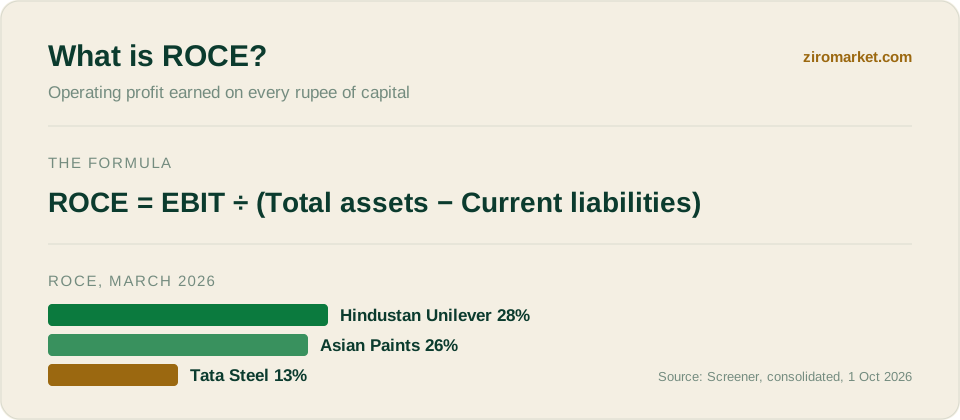
ROCE equals EBIT divided by capital employed, where capital employed is total assets minus current liabilities. EBIT is operating profit before interest and tax, the same line that sits behind EBITDA once depreciation is added back. Capital employed is everything the business runs on, from shareholders and from lenders, as laid out in the balance sheet.
What do real ROCE numbers look like?
Putting three well-known companies side by side is the easiest way to feel the metric. All figures are consolidated, from Screener, for the financial year ending in March, as of 1 October 2026.
Hindustan Unilever's ROCE crept up from 25% to 28% over four years with almost no debt, which is what a steady, asset-light consumer business looks like. Its borrowings were only Rs 1,478 crore in March 2026 against a market value above Rs 4 lakh crore.
Why does ROCE swing so much for steel but not for soap?
Steel sells a commodity whose price rises and falls, while the furnaces and mines that make it cost the same either way. When prices are high, a huge profit lands on a huge capital base and ROCE jumps. When they fall, the same base earns little. That is the pattern in the table, where Tata Steel's ROCE dropped from 31% to 7% in two years.
Asian Paints sits in between. Its ROCE slipped from 38% in March 2024 to 26% in March 2026, and its borrowings rose to Rs 3,929 crore from Rs 2,290 crore a year earlier. A fall like that is the cue to read the latest results, not a verdict on its own.
ROCE vs ROE: which one should you trust?
Both measure returns, but they answer different questions. ROCE judges the business before it decides how to pay for itself, and ROE judges what shareholders earned after interest and tax. Debt can push ROE up without improving the underlying business, which is why a high ROE with a weak ROCE deserves a closer look at the debt-to-equity ratio.
Hindustan Unilever's ROE was 31.0% in March 2026 against a 28% ROCE, the two sitting close together as they tend to when a company carries little debt. Asian Paints' ROE was 21.8% against a 26% ROCE. Reading the two together tells you how much of a return comes from the operations and how much from financing.
Where does ROCE mislead?
ROCE is not meaningful for banks and NBFCs, because their deposits and borrowings are the raw material they lend out and interest is their main operating cost. For lenders, use ROE and net interest margin instead. A single year can also mislead, particularly for cyclical companies, so five years of ROCE tells you far more than one.
A ROCE below a company's cost of borrowing can mean growth destroys value, however big the profit looks, and a steady figure above roughly 15% is the working bar many analysts use for quality. The number to watch next is how Tata Steel's 13% holds as steel prices move.