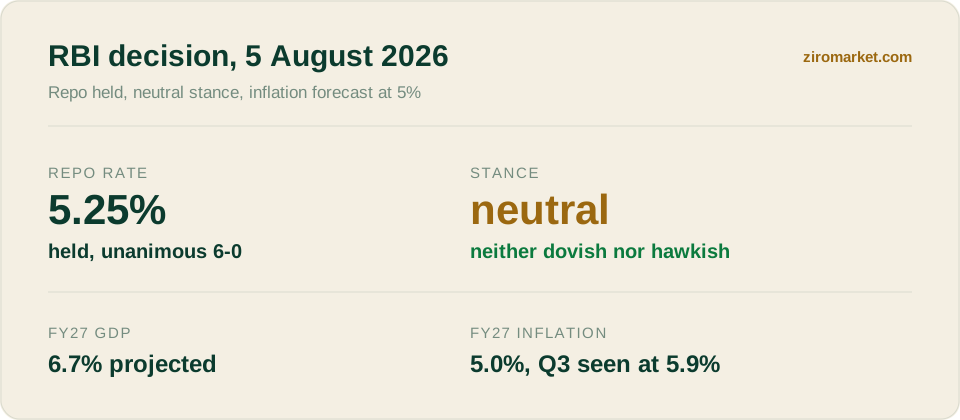
The RBI did exactly what the market expected, and its forecasts said more than the decision. The Monetary Policy Committee voted unanimously on 5 August 2026 to hold the repo rate at 5.25% with a neutral stance, and projected inflation rising to 5.9% in the October to December quarter, which is not the forecast of a central bank preparing to cut.
The repo rate has been at 5.25% since a 25 basis point cut on 5 December 2025. Governor Sanjay Malhotra described the committee as "neither dovish nor hawkish", guided by headline inflation, oil and the rupee.
What Happened
The decision was a steady hold. The MPC kept the repo rate at 5.25%, the standing deposit facility at 5.00% and the marginal standing facility at 5.50%, with all six members voting for the hold.
The forecasts carried the message. The RBI trimmed its full-year FY27 inflation projection to 5.0% from 5.1% but raised the near-term path, to 4.7% for July to September from 4.2% and to 5.9% for October to December from 5.1%, while lowering January to March to 5.5%. Growth was projected at 6.7% for FY27.
The reasoning was familiar. June inflation at 4.38% and July at 4.45% sat above the 4% target, oil was elevated by the Strait of Hormuz conflict, and the rupee was near a record low, as covered in our India June CPI piece. Cutting into that mix would have risked adding to imported inflation.
Why This Matters for Investors
The tone closed a door the market had hoped was open. A forecast that puts inflation near 6% in the October to December quarter makes a rate cut in 2026 unlikely unless oil falls sharply, which matters most for rate-sensitive sectors like banks, autos and real estate that had priced some easing.
The US backdrop did not help. The US Federal Reserve held rates at 3.50% to 3.75% on 29 July, but three officials dissented in favour of a hike, and chair Kevin Warsh turned more hawkish at Jackson Hole later in August. A Fed moving toward hikes narrows the RBI's room, because cutting while US rates rise widens the pressure on the rupee.
For households, the effect is stability rather than relief. Floating-rate EMIs and deposit rates stay put, and savers have less reason to rush into long fixed deposits before a cut, because a cut is not in sight.
Market Reaction
The reaction was muted, as a fully expected hold tends to be. Bond yields and the rupee barely moved on the day, and the Nifty's direction through August was set by Q1 earnings, oil and foreign flows rather than the policy statement, as our Nifty 2026 analysis covers.
What Investors Should Watch
The first is whether inflation follows the RBI's path. August CPI at 4.82% was consistent with the forecast of 4.7% for the quarter; a September print well above 5% would put pressure on the neutral stance itself.
The second is oil and the rupee. A renewed spike in either would keep the RBI on hold longer; a lasting fall in Brent is the one development that could reopen the case for a cut in early 2027.
The third is the Fed. After its 16 September hike, the question is whether the US projections of about 4.1% by year-end are met, because every US hike makes an Indian cut harder.
Risks to Monitor
The clearest risk is an oil shock. A renewed disruption in the Gulf would lift inflation above even the RBI's raised path.
The second is the monsoon. With cumulative rainfall about 17% below normal by mid-September, food inflation could stay firm into the winter.
The third is growth. GDP grew 7.8% in April to June, so growth is not forcing the RBI's hand for now, but a sharp slowdown would sharpen the trade-off between supporting activity and defending the rupee. This is general information, not investment advice.
By holding at 5.25% and raising its near-term inflation path, the RBI told the market that its next move depends on oil more than on anything it controls. That is an uncomfortable position for a central bank, and an honest one.